Gradientes de frío

Análisis de temperatura, tras varias experiencias invernales en Seúl:

+5ºC … mejor mete las manos en los bolsillos

0ºC … si no te pones el gorro, se te petrificarán las orejas

-5ºC … toca cubrirse parte de la cara, o tu piel sufrirá un lifting acelerado

-10ºC … ponte los guantes, con las manos dentro de los bolsillos

-15ºC … respirar DUELE

-20ºC … ni se te ocurra salir al aire libre

Por suerte, este invierno parece que no está siendo muy duro. Aun no he llegado a ponerme los guantes en los bolsillos. Ni tampoco ha nevado (copiosamente). Aunque en parte se debe a que el invierno coreano es seco. Muy muy seco. De hecho me estoy convirtiendo en una especie de pila andante. Acumulo un montón de energía estática, y cuando toco algo de hierro ¡pega un chispazo tremendo!

Tratados de libre comercio. Dinero vil.

Demostrators in Seoul City HallA los pocos días de llegar a Seúl, estuve paseando por el centro y acabé en una pequeña manifestación contra el TLC. Esto es, el Tratado de Libre Comercio entre EEUU y Corea del Sur.

En Corea, al igual que en España, existe un bipartidismo, con mayorías absolutas. Así que, básicamente, el partido en el gobierno hace lo que quiere (o lo que quieren los grandes bancos). En este caso, el gobierno decidió establecer un Tratado de Libre Comercio con Estados Unidos, con la idea de reducir los aranceles aduaneros de ambas partes. La oposición y los partidos pequeños se pusieron en contra, y hasta se montó una buena en el congreso, con granada de gas lacrimógeno incluida. Para más detalles, leer el post de Felipe sobre el tema.

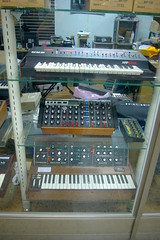
ARP Axxe & Moog MinimoogUna semana después, fui al mercado de instrumentos musicales de Nakwon, y al ver los precios de los sintetizadores americanos, más caros que en Europa, volví a pensar en el TLC. A pesar de que me gustaría haber visto mejores precios en aquellos teclados, llegué a una conclusión: los aranceles aduaneros aun tienen sentido en un mundo globalizado.

Corea es una gran potencia debido a su mercado interior. Los coreanos son los mayores consumistas de sus propios productos. Y gracias a eso, las grandes empresas (LG, Samsung, Hyundai, etc) se han lanzado al mundo desde un nido bien nutrido. Pero si ahora llegan otros al nido, existe el peligro de hambre. Es decir, el asunto no es que LG pueda vender más barato en EEUU, sino que tendrá que preocuparse mucho más de su mercado local. Aparte, tampoco hay grandes demandas de productos extranjeros en Corea, porque ya han desarrollado un mercado interno variado. Así que el tratado podría acabar siendo más perjudicial para Corea que para EEUU. Aunque, como siempre, el tiempo dirá.

Por otro lado, en Europa tenemos una economía común, y también una libre circulación de personas. Lo primero ha acabado siendo un lastre. Todos los países de la Eurozona dependen del Banco Central Europeo, y al final los países pobres acaban siendo controlados por los ricos, con la excusa de la economía. Véase los golpes de estado encubiertos en Italia y Grecia (donde los nuevos jefes de gobierno NO han sido elegidos democráticamente). Sin embargo, la libre circulación de personas, ha sido todo un éxito. La gente encuentra la libertad de moverse y vivir donde realmente encuentra interesante, o donde hay trabajo. El visado si que es algo que deja de tener sentido en un mundo globalizado, en donde en menos de 1 día puedes volar al otro lado del mundo.

Personas vs. economías. ¿Quién ganará?

How to move to Asia without stress

Ok. That’s a stupid title. It’s impossible to do a moving without stress. And if you are moving to another continent, the thing is worse.

Said that, I have been thinking about making a list of some of the problems and unexpected things I found while moving from Barcelona to Seoul. 9500Km far away. Into another world. Another culture. Another language (that I don’t speak yet).
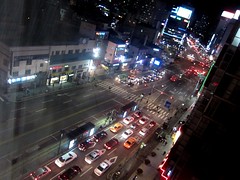
Sinchon at nightVISA & LANGUAGE
Unluckily the world still have frontiers for people. That means you have to ask for a visa if you pretend to live, instead of being just a tourist. In my case, I found out that getting a student visa, joining a Korean course, was the easiest option. Anyway, I expected to learn the language, to be able to communicate with local people. Of course, nowadays you can live in any place in the world just knowing English, but it’s better to learn the local language. So, joining a Korean course you get a visa that lasts a bit more than the course itself.

I joined level 1 course in Sogang University. Apparently, everybody say this Korean course, compared to the one in other universities, is really focused in speaking. And that’s true. We practice speaking from the very first day, which was overwhelming but funny at the same time. The course lasts for 3 months, and it’s 4 hours every day. I paid around 1000€ for it.

MONEY & HOUSE
Here there is a clear rule: you are going to spend more money that you expected, even taking into account this rule. The course was 1000€, the flight was like 600€, the first week in a hostel around 200€. And the house, a huge amount of money.

In Korea, in the past, they used to have a curious way of renting houses, called “jeonsei”. Basically you pay a lot for the “key money” (more than 6000€), and later you don’t need to pay the monthly fee, because actually the owner subtracts it from the key money. However, nowadays they rent houses using the Western style, paying monthly. But they still have in mind the old style. That means they will ask a lot for the key money. In my case I was really lucky, and got the house just with 3000€ of key money.

The monthly rent in Seoul is cheaper that in Barcelona
. But there is a big difference between prices. In my case, I really wanted to live near the university, so I have to pay an extra, because it’s a “cool” area. With the help of some Korean friends, I found a house that matches most of my wishes. It’s a one-room, 24m2, plus a 4m2 bathroom. It could be small for Western standards, but it’s pretty big and new for local standards. The house-room is basically 4 walls: 1 wall with a desk, another with the kitchen, another with the bed and closets, and another with a big window with a nice view of the area. I pay around 550€/month, without bills. Moreover, I had to buy a lot of house stuff, from dishes to a office chair.

Funny enough, you don’t need a foreign ID card to rent a house, just the passport. But you can’t open a bank account without a foreign ID card. A Korean friend told me that they consider a bank account a more important thing than a house!

Summing up, if you want to move to Asia, and pretend to have a normal house, be ready to invert at least 5000€.

Extra thing: it’s not really easy to move money from one continent to another. It’s better if you go with (at least) 2 credit cards, from different banks. And remember that a international wire transfer can take several days.

PEOPLE
I remember that when I moved to Barcelona, I was lucky to stay some of my first days there in Gabriel & Laura’s house. I met them only once, before moving, so we were almost strangers at that time. So it was really nice from them. But in Korea nobody offered me his house. So I booked a private room in a hostel for 1 week.

It can be easy or difficult, regarding people. If you have close friends or boy/girlfriend in your destination, the moving could be easy. But in my case, I just knew some people. So I couldn’t expect so much help from them. Remember, people are busy, and it’s possible that couldn’t help you at the time you arrive. Luckily I found some Korean that helped me A LOT with all the stuff.

FOOD & DAY LIFE
Food is different. So you have to adapt. One thing is going to a Korean restaurant from time to time, and another is eating there every day. Also, if you like cooking, be ready to change your recipes with new ingredients. Even simple things like salt can be quite different.

When yo do normal life in a foreign country, you have to learn things from zero again. For example, I got a document with instructions on recycling. My building has a schedule for trashing different stuff. Of course, the document is only in Korean!

…anyway, I’m enjoying the experience!
A testament for my Barcelona life

A couple of months ago I decided to finally jump to another life, to another city. In these days, my last few days in Barcelona, I’m experiencing an hurricane of emotions, regarding things to leave and things to discover. And the most important: people.

I arrived to Barcelona 7 years ago, as a bridge to Europe. My plan was spend a year or two in this city, and then move to some city in Europe, like London or Maastrich. But the feeling of this magic city hugged me. And here I am, 7 years later. But finally I decided to give a try to another city. A city that is not in Europe, but in Asia. Seoul, a city with Soul!

It’s funny to see how I arrived to this situation. Like in a Go game, you make some moves, and life answer with other moves, so later you try to make new moves using your past moves as well as you can.

These days I’m writing my testament for my Barcelona life. I’m giving this chair to Jordi, the microwave to Oscar, the Amelie poster to Ricard, some Go books to Joan, the barbecue to César, the whiteboard to Ramón, the closet to Alex, etc. It’s like I’m splitting myself into a thousand pieces, and spreading them among the people who are truly my great friends. It’s like a funeral, but with a smile. Sad but happy. My stuff will live in my friends’ houses.

And, of course, I’d like to meet you all in my future new house in Asia! 안녕!

Mexico DF: a love hate

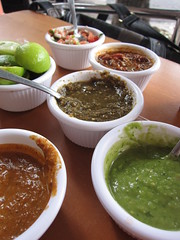
Side saucesSometimes you can feel both love and hate for something. It happens to me with Mexico DF. I’m again in this crazy city, exactly 2 years later of my first stay.

This city is really noisy. The perfect definition of chaos. Traffic lights are considered only a suggestion. And the air can’t be called “air” at all. This air is so so polluted: just imagine a city with 20 million people, 50 Km wide, with cars everywhere, and only a big park. A city at 2600m above the sea level (that is, less air density), in a closed valley, where it almost never rains (so there is no way to clean the dry air). You really have problems breathing. In my first stay my nose even bled. And you can barely see plants on the balconies.

On the other hand, the food is good and cheap. If you don’t care missing fish, however. But after some days eating tacos and quesadillas, you will stop eating in the street places, and look for a decent restaurant. Also, people are really friendly. Always trying to smile and joke.

So, somehow this contrast, crazy city but friendly people, forces me to look with different eyes. If people can be happy in this disaster of city, it should be not that disaster, but just “different”. If you start looking at the city with different eyes, with a curious innocence, you will start seeing beautiful things all around. Breaking concepts in your mind. Making your vision of things more flexible.

Love-Hate!

What’s a house?

Why do we need a house? When we start in this world, we live in our parents’ house, and later when we grow up, we try to find our own house. A place to sleep and to keep all your stuff. Is this a social need or it comes in our genes?

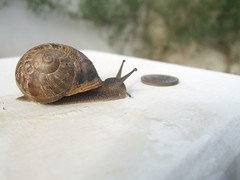
Snail looking for moneyWhen I lived with my parents, my personal space was my room, and some other corners of the house. Later I moved to Barcelona, and shared a flat with other people. My house was actually my room, but my flatmates didn’t respect my space, and I have to move to another place. Then I was the rent-owner, and other people came to live in “my” house. All my stuff was in different rooms. I also moved to another house, with all my stuff (including furniture) and lived alone. Is your stuff what defines your house?

Meanwhile I travelled quite a lot, and slept in a lot of different places, from somebody’s high status house to a tent in the jungle. And I felt those places, most of them, as my house. Is a house the place were you sleep?

Finally, I enjoy a lot having visitors in my house. So perhaps a house is the place where you have your stuff, where you sleep and where you host other people.

· Can you put all your stuff in a single suitcase? Then your house can travel with you easily.
· Can you sleep in any place? Then your house can be any place in the world.
· Can you welcome a visitor, and show him/her the city, even staying in a hotel? Then you can feel any city as your hometown.

These days I’m getting a lot of chances to travel and live around the world. From Mexico to Argentina, from Hungary to Korea. And despite I love my house with my beautiful terrace, sometimes I think that my house weighs down my flying spirit. I envy the snails, who travel with a house, but having a camper is not the solution. The solution is to lose weight, to find ways to have less stuff, or to keep it in cheap places. And then, fly!

Enjoy the trees

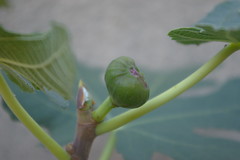
First fig growing I live in front of a mountain, and there are some fig trees. When I walk around, in spring and autumn, I can enjoy the fragrance they blow in the air. Actually, fig trees’ smell is neither strong nor delicious. But the subtle smell reminds me, somehow, of my childhood, and a good reason to live.

When I was child, I used to play in my grandfather’s backyard, where there were two fig trees and some palm trees. My grandfather was a self-taught, that learned several languages, maths, physics, etc from books, in a time without internet and libraries. He used to teach me a lot of things. And I remember one day, he said: “I learned a lot, and I wish there was a way to put all this knowledge in your brain, even if I die just after the process”.

Some years later, I was the one who wish there was a way to give my young body to him. He got cancer, and little by little his body and mind turned off. One day, he barely could move away from bed, and thought about suicide. He told me: “I can’t enjoy the trees any more, I can’t go to the country side, I can’t go outside…”. Luckily, for the family and him, he passed away just some days later.

Perhaps the most important life lesson he taught me was just: enjoy the trees. Like the subtle smell of the fig trees. Or seeing how the branches change when I walk around a tree. Or listening to my cousin, gardener, explaining me how my fig tree is developing new branches in some places, to balance the weight of the main trunk.

Nature is wonderful, as life is.

Korea again, some green ideas

Another trip to Korea. This time I used my Easter holidays, and a kind host invitation of a Korean friend, to travel again to the land of kimchi. I stayed 9 days in Seoul, but this time just to enjoy the city and the friends, instead of studying Go and working during the mornings.

I’m starting to think that Seoul is one of my favourite cities. Actually, regarding Flickr’s statistics, I have already more pictures of Seoul than Barcelona, despite I’ve been living in Seoul just 2 months, and 6 years in Barcelona. Some months ago I started to think about moving to another city, and this one can be a great candidate. Actually, if you join a Korean language course in any university of Seoul, they arrange all that you need: house, visa, etc. So I could go there, work in the mornings and learn Korean in the evenings.

But today I just want to write about some nice ecological ideas I saw in Seoul:

Supermarkets have old boxes for free. Next to the exit of the supermarkets, they leave all those original boxes that were used to carry the products from distributors to the supermarket. So buyers can re-use those boxes, for free. There is even adhesive tape for free. It’s the best 2nd R (of the 3 “R” about recycling) I’ve seen in long time.
The public transportation is really efficient. The subway and bus are not the cheapest I’ve seen, but the transportation grid is pretty impressive: lots of subway and bus lines, that take you to any place around the city. Of course, the city suffers of traffic jams, but if you know that all trains and buses have WiFi, will you take the car often?
People really care about recycling. I hate watching my neighbours in Barcelona throwing big bags of trash, without doing any recycling at all. In Seoul all people does recycling, young but also old people. Depending the neighbourhood, sometimes the laws about it are really restrictive, for example, you can’t throw any plastic bag into the organic container (thing that makes sense). The sometimes sad thing is that old people, who don’t get enough pension money, use to collect and carry old boxes for getting some money when recycling.
The city is covered with nice mountains. In Barcelona I live close to Montjuïc, but I feel this mountain has too much concrete. In Seoul mountains are real mountains, where you can get lost. They really keep those natural spaces!

Of course, that doesn’t mean Seoul is a green city. It’s not really bicycle friendly, for example. But some ideas are interesting enough to try to import.

World Heritage Sites

A new year started. A new time to fill will feelings and experiences. I wondered where I will travel this year. Thinking about travelling, I imagined myself going again to the jungle, or at least some stunning natural place. Visiting old ruins. The world is wide, and I have no preferences.

Having no idea on travel destinations can be a problem. Then an option is to check typical lists of “important things to see before die”. My favourite list is actually a representative list of what humans can make: UNESCO World Heritage Site list. I remember, for example, that this list gave me ideas of places to visit, while staying 1 month in Mexico in 2009. Actually I have experienced just some places of this long list:

– Belgium – La Grand-Place of Brussels, Historic Centre of Brugge
– Germany – Aachen Cathedral, Cologne Cathedral*, Museum Island in Berlin
– Korea – Jongmyo Shrine, Changdeokgung Palace*
– Latvia – Historic Centre of Riga
– Lithuania – Vilnius Historic Centre
– Mexico – Historic Centre of Mexico City and Xochimilco, Historic Centre of Oaxaca and Monte Albán*, Historic Centre of Puebla, Pre-Hispanic City of Teotihuacan*
– Portugal – Monastery of the Hieronymites and Tower of Belém in Lisbon, Cultural Landscape of Sintra*
– Russia – Centre of Saint Petersburg, Kremlin and Red Square in Moscow
– Spain – Works of Gaudí*, Cathedral of Seville, Historic Centre of Cordoba, Mudejar Architecture, Doñana National Park, Palau de la Música Catalana & Hospital de Sant Pau in Barcelona*, Palmeral of Elche
– Syria – Ancient City of Damascus, Ancient City of Aleppo*, Crac des Chevaliers and Qal’at Salah El-Din*
– UK – Stonehenge, Tower of London, Westminster Palace & Abbey, Castles and Town Walls of King Edward in Gwynedd (Wales)*

* places that really fascinated me

Well, it’s funny to see I’ve barely visited places in Spain. And, despite I’ve been in Costa Rica twice, I’ve not visited any natural world heritage there (perhaps because those places are really inaccessible, like Cocos Island).

I should pick one country and visit all the places in this list. This would be a nice trip. Don’t you think so?

10 years to master

You need 10 years to become an expert on a field. No more, no less. 10 years of continuous effort. Think about a famous musician, a famous athlete or even a professional Go player. There is at least 10 years of hard-work in almost all cases before he becomes a star.

Looking at this video, I imagine those 10 years he spent improving his technique:

When you start with a subject, you experience different statuses, from novice to expert. But there is a key point that only an expert can do: he makes it look easy. As if you can take your bike and do same things showed in the video. Actually I could say I have 8 years of experience on Go, and perhaps 10 years on PHP, but I feel there is still a lot to learn. Despite sometimes people see that expert magic on me.

I wonder which new expert skills I’ll have in 10 years. Things that you start now doing often can become key points of your life. Things that perhaps you don’t really consider, like gardening or doing DIY. So, be sure to avoid wasting your time, and focus on practicing interesting skills. We’ll see what happens in 10 years.