Your head as a RADAR

After several months, Howard discovered many ways to compensate for his hearing loss on one side [ear]. […] “I no longer had to close my eyes if I kept scanning the scene by moving my head in a side-to-side motion, with a very slight up-and-down wave motion.”

Composer, ethnomusicologist and virtual reality pioneer Jaron Larnier is concerned with designing virtual reality with the greatest possible visual and auditory fidelity. He stresses that micro-movements of the head (movements of a few millimetres, or tiny rotations), performed automatically and unconsciously in fractions of a second, occur even in those with perfect binaural hearing and are, indeed, necessary for precise sound location.

Musicophilia, by Oliver Sacks (neurologist, author of Awakenings and The Man Who Mistook His Wife for a Hat)

Six years

Six years ago I landed in this city. I’m not sure I like cities, but somehow I ended up living close to a mountain, but at the same time I’m not far from the city center. I could say this is the best of two worlds: I can grow plants, I can enjoy nature, but I can enjoy city life. What a contradiction. I like my house, but I like travelling. I like nature but I live in a city.

The different experiences of these six years shaped me. I wonder if I had experienced similar things if I had chosen a different destination. My original idea was to think about Barcelona as a step of my travel to Europe. But it trapped me, six years. How could have I stayed here so long, when the world is waiting for me? So many places to visit, to stay, to experience.

It’s time for new places. But the future is always blurry. I have no idea where I will land this time. But I’m sure it’ll be good, because I will be there.

Travelling tale

I love this tale:

A backpacker was travelling and visited a wise man.
The house only had a small bed and a bowl for food.
The visitor, surprised, asked the wise man:
– How can you live with so few things?
– Your backpack is small, too.
The visitor then explained his case:
– It’s small because I’m travelling.
So do I.

My favourite TED Talks

I discovered TED Talks some years ago. I think the first one I saw was Barry Schwartz on the paradox of choice. A really interesting one. But at that time I saw it on youtube. I didn’t explicitly go to the TED Talks website, I just saw some talks on youtube, or google video.

Some months ago, thanks to TED’s twitter user, I went passionate about the talks, and started watching an average of almost 1 talk per day. If they start a TV channel, it will be the default one when I switch on the TV. Also I started to visit TED’s website and signed up.

I’d like to share with you my favourite TED Talks list. Enjoy!

The “read it all” challenge

Nowadays we don’t read, we scan. Internet is an amazing source of information, but somehow we have evolved our reading to cope with the huge amount of information on the net, not reading deeply any more, and just scanning. This is no news, as everybody has noticed it, and actually the famous usability evangelist, Jakob Nielsen, wrote about this subject in 1997.

Moreover, all modern browsers come with tabs, allowing you to do parallel surfing, so we read even less from a single page. People tend to have a lot of tabs, spreading the focus, and barely reading any page at all. In addition, this behaviour unluckily infects our way to read things off-line; lots of people have reported problems of focus while reading a book. And better to avoid speaking about e-books.

In 2008 a famous article, Is Google Making Us Stupid?, went a bit further:

The faster we surf across the Web—the more links we click and pages we view—the more opportunities Google and other companies gain to collect information about us and to feed us advertisements. Most of the proprietors of the commercial Internet have a financial stake in collecting the crumbs of data we leave behind as we flit from link to link—the more crumbs, the better. The last thing these companies want is to encourage leisurely reading or slow, concentrated thought. It’s in their economic interest to drive us to distraction.

After reading this really long article (I read it, didn’t just scan it, I promise) I was really shocked, and had an idea.

The challenge is simple: during 1 day read absolutely all words of the main text of every single page you open. That is, you don’t need to slow-read the adverts, but try to read all the genuine content of each page. I tried it and it was surprising to see how slow the web browsing experience can be, and at the same time how deeply can you focus in just one thing. Are you brave enough?

Corea, capítulo 2

De nuevo vuelvo a Corea, donde me esperan nuevas aventuras, pero esta vez acompañado de 2 jugadores más, Joan Alemany de Barcelona y Ángel “Pascualino” Pina de Murcia. Para intentar aportar más información, he montado un blog donde los 3 iremos escribiendo: badukaires.com

Si alguien quiere leer todas mis aventuras anteriores, están en la sección “Korea” de este mismo blog.

Uploading music: Jamendo vs Soundcloud

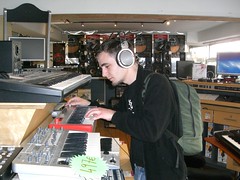
Tweaking the Alesis MicronRecently I got interest again in composing music. Moreover, I wanted to explore some options to publish my music on Internet, so I packed some of my (really) old tracks and tried to upload them to some websites.

The first option could be just to upload the files to www.liopic.com and use a Flash widget to let the visitors play the music. The problem in this case is the big use of bandwidth and the lack of “discoverability” by non-related people.

In order to explore other options, I started to search using some premises: a public website, that lets people comment tracks and creative commons publishing options. That discards places like grooveshark or the dying last.fm.


Jamendo
My album there
Obviously, speaking about copyleft music, Jamendo is the most popular place, and totally free. It has a lot of users that, in theory, creates a nice community. Actually the website is a bit web 1.0 style, with a sometimes uncomfortable navigation. It’s good to listen to an album, but not really easy to listen to a kind of music. Perhaps I got too used to Last.fm tag’s radios, but I feel that the just 6 radios are plainly not enough, specially if there is no random ordering. But the worst part was uploading my music: it tooks 5 days to publish it, until they validate it! So, not my favourite place, even I got an album review.

Pros: lot of people, totally free
Cons: 1.0 style, painful uploading, just 6 radios


Soundcloud
My profile and music there
I discovered this website almost by mistake, while following Moby on twitter; he published his new album on soundcloud. I raised my eyebrows when I see the wave player with the option to comment on a time position of a track: that’s a fantastic idea. I uploaded my tracks and they were published instantly! And I feel the sound quality is slightly better than on Jamendo; I noted less distortion in the beginning of “Jinx” using my 100€ headphones. The site’s navigation is web 2.0 style, but again I feel it’s a bit difficult to find something like tag’s radios. However, on Soundcloud an alternative way to get radios is playing a group tracks. You can license the music as CC or with normal copyright. Finally, if you want to upload more than 2 hours of music, you have to get a pro account: that’s not bad, cause I understand they should get some benefits, and actually the prices are in various ranges, starting at a reasonable 29€ for year. Perhaps I’ll pay.

Pros: nice player, 2.0 style, all kind of publishing options
Cons: not so many users, lack of a real tag’s radios

Limiting the stream

Some months ago I deleted my facebook account. And some weeks ago I removed my account on friendfeed. Why? Despite I liked it, I found out that it took me a lot of time.

Actually the problem is simpler that you could expect: friendfeed is a too good aggregator. That is, it posts all the pictures you add on flickr, and all the entries you do on twitter. And sometimes I wanted to have my “stream” summarized somehow, so I got used to remove quite a lot of the friendfeed’s posts manually. Finally I gave up.

However I think it is a good idea to have some kind of “clippings” manager. And friendfeed was good for this. But I wonder if it’s better to publish here all kind of things, or keep my blog with just my own ideas and set a “clippings” site somewhere else. So for the moment I’m trying the second option, and I created an account on tumblr.com. Tumblr.com is quite similar to friendfeed, but a bit more focused in just posting clips and less in the feed aggregator and commenting stuff. Let’s see if this fits my logic.

Brain development in Go

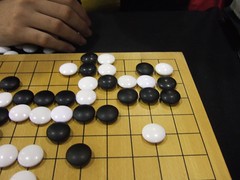
The big tesujiPeople think that playing Go will develop your logical thinking power, that is, the skill used to calculate out sequences. Sometimes they say the effect of playing Go is getting a logical mind, other times the effect of having a logical mind is falling in love with Go. At least this is the usual feeling in Europe’s Go community.

Surprisingly I’ve met some professional and really strong Go players that don’t look like a “logical mind” at all. They are emotive, they make silly mistakes, or just in a word: they are “normal”. Actually, Go develops a lot of different parts of the brain, and not only the logical skills, despite what we usually think in Europe.

Let me quote some of those parts (extracted from a Korean book on Go education):

· Opening (fuseki): Building territory frameworks develops spatial sense.

· Corner patterns (joseki): If you study the reasons of the moves (in theory the best moves for both sides) you will get better comprehension and memory.

· Tesuji and life and death problems: Finding the vital point of shapes helps your logical thinking power, but also your intuition.

· Middle game: While deciding which battles are the correct to start you work your judgement ability. Of course, your creativity and your adaptability is highly stressed too.

· Endgame and final score: Counting the value of the last moves of the game, and counting the final score, helps your mathematical abilities.

· Game review: Replaying the game develops your memory (patterns).

So a lot of parts of the brain are touched, from left to right sides. As a brain exercise, Go is a quite complete activity. Compared to other so-called brain-helper activities, like solving sudokus, it’s obvious that Go is far better. Only complex games like Chess can be a subject of comparison.

P.S: I’m in love with Korean baduk books. In Europe we get only Japanese books, translated to English, and most of the time they focus on “the magic”, explaining things without order. Korean books, however, have an extremely good methodology!

How to sell Go? An amateur market study

Running to the centerAs I said in my previous post about spreading Go, looks like nobody has done a real “market study” about selling Go. It’s really easy to realize there are 3 separate “targets”, perhaps 4, based on the age, and for each case a different approach has to be applied.

· Children
They do not decide, parents decide for them. This means you have to sell Go to the parents, telling them that Go will help the kid become more intelligent. As a mental discipline, this is a reality, and actually some studies show improvements in IQ and concentration on children who started playing Go. Different parts of the mind are improved, from spatial sense to coherent judgement, and not only calculation abilities.

The problem here is the infrastructure, that is, the things we need to support a Go academy for kids. We need teachers, we need good books for kids in their mother tongue, and we need continuity. We have to train players to teach properly to children, because nowadays most of them are horrible at teaching. We have to create relations with Go books publishers and try to translate books for children to our local languages. And (the most difficult part) children should keep playing/studying. Usually in Europe an amateur player goes to a school and runs some kind of Go introductory course; then they learn to play. But later, when the the course is over, they do not continue playing. That’s because the only way they have to continue playing is in a real club (with people smoking or using bad language) or on Internet, and parents do not allow it most of the time. So the way to keep children playing is creating a children-focused space (real or virtual) for them, with some teacher/tutor/guard taking after them.

· Teenagers
Actually not so much work is needed with this group. They usually discover the game via Hikaru no Go, and start playing a lot, spending the enormous free time they have. The only problem they suffer is their tight budget. That is, it’s not easy to buy a Go book, which are quite expensive here, starting at 15€. Moreover, it’s not easy to travel to take part in a tournament. So the action to take here is try to lower the prices of books (perhaps prepare a grant for this), and help them to take part in real tournaments.

· Adults
Why don’t we just sell Go telling people it’s a fun game, instead of a complex one?. Usually adults looks for activities to enjoy with, in their spare time. If you tell them Go is a complex thing, most people will not look at it. So the idea here is selling Go as an enjoyable game, with a bit of “it will keep your mind young”. Think about all those “brain training” videogames that are succeeding lately; despite in theory they are boring (you have to solve maths) they sell them as an enjoyable game, and people keep buying. Of course, you also have studies on Go and brain activity to use as background. Moreover, Go magazines or newspapers could keep adults playing the game.

· Elders
Do you know that Go helps to prevent dementia? This could be a nice slogan to start with. There are studies which show that mental activities like Go help the brain to remain healthy. They have a lot of free time, so introductory courses could help. Also they can take part in tournaments, read magazines and such.

So summarizing, we should STOP telling people Go is a complex thing!!