A curious Zen story

KNOWING FISH

One day Chuang Tzu and a friend were walking by a river.

“Look at the fish swimming about,” said Chuang Tzu, “They are really enjoying themselves.”

“You are not a fish,” replied the friend, “So you can’t truly know that they are enjoying themselves.”

“You are not me,” said Chuang Tzu. “So how do you know that I do not know that the fish are enjoying themselves?”

(almost stolen from renegade Zen)

Absolutely English .vs. Holeness Spanish

English language is more formal than Spanish. You should say/write every single word of a sentence, avoiding “ellipsis” (leave out words). On the other hand, Spanish language uses a lot of ellipsis. An easy example:

“I was cooking a paella, when she saw me, and {she} asked me {if I could} teach {her how} to cook {paella}”

In English you usually say all the words, and if you forget to say one probably the other person ask you about the meaning. In Spanish you can say the previous sentence without all the braced words, and your listener will understand you perfectly. It’s an economic way to use the language, quicker; but it doesn’t mean it’s better, because we have a lot of ambiguities. Sometimes having these ambiguities causes problems, but sometimes they are usefull (when you don’t really want to say anything, or you want to hide the real meaning of something which you don’t want to show).

Anyway, this week my head is playing with the thought: “I (or we, Spaniards) do a strong use of the context information”. This is quite interesting, because I discovered a lot of situations, while speaking with English people in English, where I don’t really need to understand every single word they say. I strongly use the context information to guess, in an automatic way, what they are going to ask me. In fact, sometimes I answer instantly, without a real process of thinking and understanding. I’m not sure if this is good or bad… have I a lazy brain or a wise one? It’s disturbing when sometimes I’m not sure if the stuff I just understood comes from a good listening or from a good context guessing. How weird!!
Stonehenge, the 1st computer made by humans?

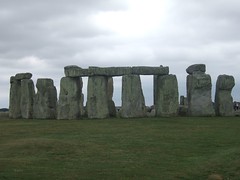
StonehengeToday I have visited Stonehenge, one of the most outstanding prehistoric monuments. I spent two hours (by bus) to arrive there, and I can say this journey is paid off. The place is really excellent for astronomy purposes, because it has a perfect horizon, without hills or mountains disturbing the skyline. You can see only some of the original stones it contained, just the stones which are still there.

They made this to establish and study the seasons. There are stones marking the position of the Sun in the different season. Nobody really knows how those humans did it, how they brought the stones from far mountains, how they put them in perfect positions. I know there are recent studies (made with the help of computers) which show an incredible variety of lines between the stones, pointing to different (and exact) positions on the horizon. Anyway it’s a really enjoyable journey for an astronomy hobbist (or ex-hobbist, as I am).

And I must say I was lucky in my visit, because some people next to the place were blowing a big balloon, and they offered a trip for free. So I took some pictures of Stonehenge from a bird’s view! Excellent!

Sometime ago I read in a humour novel about computers that said “the first computer made by humans was Stonehenge”, because (roughly speaking) it “calculates” something. So, for me, this journey wasn’t only a visit to a prehistoric monument and an astronomical place, but also a computer science and engineering construction!

Go in Bournemouth

Yesterday I had an excellent time playing Go!

I looked for some Go players in Bournemouth (where I’m staying for my holidays), and I found a phone number at the British Go Association website. I rang him and we arranged a meeting. He was totally surprised: he received a call from a player with a Spanish accent, looking forward for some games. I went to his house, and I met some local players, from 1 dan to double-digit kyus.

My first game, my presentation letter, was a chain of tough fightings! Kiai from Barcelona. “What a surprise!, normally Bournemouth players are really agressive, so it is strange to see one of them being attacked”, my host said. I played two more games, and we spoke a lot… about Go politics and such things. Surprisingly they have the same problems like us, for example, there is a really strong player in the city (I think he is 5 dan) but they avoid to see him because he belongs to a sect.

Also I promoted Barcelona’s tournament, because it’s easy to arrive from Bournemouth airport (to Girona). So maybe next year we will have some British players 🙂

Holidays: Bournemouth day 0

Finally on holidays!

To start with, I’m going to stay in Bournemouth (in the south of UK) for 2 weeks. I have just arrived and everything seems fabulous. The people, the house, the neighbourhood. Anyway I have to change 2 things in my mind, quickly: 1st is to think in pounds (not in euros) and 2nd to think they drive on the opposite side (so I have to take care, even though I’m only a pedestrian).

The first surprise here was a thing they said: “your English is good, so why do you need to come here?”. Oh God! Everybody says my English is quite good, but I still feel it’s not enough. Anyway I’m expecting to improve a lot in the next 2 weeks 🙂

Where are the basics about databases?

At the office I’m working on a big website, with a blog, a forum, other things, and a “shared” user system: so you only have to sign in once and you can surf from one module to another (blog, forum) without the need of signing in again. The client wanted standard and well known modules (like “wordpress” or “phpbb”). Because of this I’m studing the inner operation of these web applications. The idea is to bypass or to change its login system and to use mine.

database iconSurprisingly I have discovered some lack of proffesionality in the database definition of “phpbb”. The user’s table allow to have duplicated login names! Even more, the “login” field is not the “primary key”. I don’t remember the whole details about database creation, which I studied in my degree, but the first rule was “if you have a field which defines without confusions an entity (a row), you have to use it as the primary key of the table“. For example, the national id number for persons, or the reference number for a bill, or the login for users of a computer system. “If you don’t find a clear field to define a row, you can create an ‘id’ field, defined as an autoincremental integer“. But I have seen a lot of people applying the second, without thinking. It’s easy to always create an ‘id’ field and avoid thinking about the basics… to be careless. But for me it’s not the correct option.

Again I feel there are too many people working as programmers without a real knowledge background. It’s easy to create websites, but it’s not so easy to create them WELL. In fact some people in the office dosn’t have a real degree, so it’s impossible to discuss with them about technical questions (especially when the reasons they use are things like “I’ve read it in a forum” or “making lots of modules is good to avoid the vertical scroll in your code editor”, incredible!!). This is a hard world for the people who believe in proffesionality, like me. We have to fight hard! Hasta la victoria siempre!

More on Last.fm

Last.fm new playerThis weekend Last.fm has changed its look & feel. Now you can see more information about the music you are listening to. And there are new features! They create a “recommendation radio”, where you can hear new music, and they add a pretty nice fader to filter songs, from popular to obscure. Great! Even more, they have just released a new player, with more options. A really good job from Last.fm crew. I have decided to subscribe when I return from my holidays.

By the way, I have discovered I’m in three “top fans” lists from different bands: Tindersticks (the best chamber pop), Los Planetas (an alternative indie spanish group) and Kepa Junkera (folk music from the Basque Country). I didn’t expected to be so freaky!!

Finally, I have to comment something. Sometimes, especially when I’m listening to ambient music, suddenly I would like to make some music. But now I have a lot of work to do (I want to finish a friend’s website), and little time, so I have to prioritize, what a shame, why don’t we have more time?

Sad news from far, good news from near

This week I’ve been reading news about Israel and Lebannon hostilities with sadness. I hope they will finish soon. Some days ago I spoke with a french friend who is living in Damascus, Syria (which is next to both countries). She told me her worries… and we started to speak about political implications, those madness bombings, and people’s feelings there. So sad.

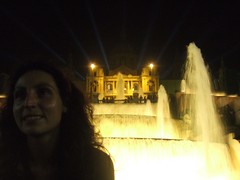
Esther and the fountainsOn the other hand, I’m pretty happy to have the visit of my friend Esther from Germany. She is going to spend the weekend here. Also my cousin came yesterday and left today, so last night at my home we had a lovely time!

Now she is at the beach (and I preferred to stay at home), so I’ve done a small autobiography for this website.

10,000 songs in 10 months

Today I have just broken the 10 thousand songs “barrier” in Last.fm! I don’t know anybody who has done it.

Last.fm is a website (web 2.0 style) which records the name of every song you play in your computer (you should install a plugin to do this). With this information they made charts, and calculate “neighbours” (people with similar musical taste). Also they offer “radio stations” of different origins: type of music, neighbours and fans of a particular group.

I signed up last year, and since then, I’m really happy with this service. They helped me to find new interesting music; in fact, most of the music I’m listening to, today, were discovered surfing this website: Röyksopp, Death Cab for Cutie, The Postal Service, Boards of Canada, Lambchop, Tindersticks…

Even more… they help you to put information, about the music you are listening to, in your website. Here it is my recent listened to tracks list.

1001 reasons to beware of your knowledge

At bed-time, I’m reading a Go book called “One Thousand and One Life-and-Death Problems“. It’s a collection of problems to challenge your mind. The interesting issue is that most problems are quite easy, but anyway you spend a lot of time trying to solve them. Why? Because they make you think, they put in doubt your self-acquired knowledge. Sometimes you see a problem, and (without a really thinking) you say “it’s impossible, there is a mistake for sure”… but it’s only a first impression made by your lazy mind. This is not good. So this book helps you to break this subtle barrier between lazy and real thinking.
In Go, you learn a lot of shapes. You see them over and over, and you usually “absorb” them. But all of your knowledge can be questioned, so you have to be really cautious applying them. For example, the 3 stones straight shape (A1-A2-A3 in the figure) is (according to me) a 1-eye shape. Also, the 2 stones shape (C1-D1) is an eye-stealing standard shape. So, when you take a first look at this problem, which the title is black to live, you quickly think it’s impossible, because you know you need 2 eyes to live (and in the figure: 1-eye-shape plus 0-eye-shape is less than 2-eyes). But, wait a moment, there are only 2 posible moves to play (at B1 and at B2) so… why don’t you calculate both? Why do you assume it’s imposible? Why don’t you use your mind to do some real thinking? I’m sure in real life, during a tournament, a lot of people missread this situation, with time running out, and leave with a loss. It’s a bad thing to assume (ass+U+me, as my english teacher says).

Your knowledge is not a help to make you avoid thinking, but a tool to help you in different ways, to offer you wide possible solutions, and to help you to create new solutions, for the problem you are facing. And this is true not only for the game of Go, but for all knowledge you have in your mind (from engineering to social things).