A better problem for my flatmate : The bear in the window

Yesterday my flatmate was complaining about my previous post. He read it, and he found the solution quite quickly… he asked for a real challenge. Then we started to comment logical problems throughout the supper. And now, I’ve prepared a big one.

“The bear in the window”
I was a bit bored at home, so I decided to have a walk. I walked 10 Km to the South, then I turned left, walking straight 10 Km to the East, and then I turned again, going 10 Km to the North, directly arriving to my home. Then I opened a window, and I saw a bear in the outside. Where my house is?

If you want to see the “easy” solution, look at the first comment. And no, there is no mistake in my walk-path. Moreover, my house is a normal house, and it’s on the surface of the Earth.
Problem: When a day is not a normal day

Monday morning. I’ve just arrived at the office, and I see my first task to do: fix a bug in a calendar from one of our websites. Actually there are 2 calendars, and one calculation to show the difference in days between the two dates. Somebody discovered a weird behaviour when you select a range of days in the end of March… the difference of days is not an integer number, but a float one!

I isolated the problem, shortening the range of days, until I discovered that the problem is in the last weekend of March. From Friday 23rd to Monday 26th of March, there are 2.95 days (instead of just 3 days). What’s happening that weekend? Why is the last weekend of March somehow weird? Any idea?

If you want to know the solution, see the first comment of this post. Tip: I use a PHP function to convert the dates into integer timestamps (seconds), I substract these integers, and finally I divide by 3600*24, to know the difference in days.

Spanish Championship Finals : A psychological view

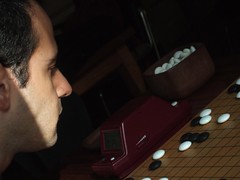
Dimas in light On the last weekend I was helping in the course of the Spanish Go Championship Finals. I went to note down the games played by the 8 candidates in my laptop. But luckily I discovered an open WiFi net, therefore I decided to broadcast in live the games, on KGS (a Go server). I was happy to see a lot of people watching my broadcast (around 30 observers in the 3rd round), and thanking me for my comments.

In my comments I didn’t focus on the board situation (I can roughly understand what a Dan player is thinking), but I described the faces of the players. In Go, as in any confrontational game, the “psychological game” has a lot of weight. Sometimes they put a stone on the board with a strong hit, remarking security or angriness; other times they put it with a calm and subtle movement, like telling you it’s not an important move (or a deep-thought one). The faces also showed the mood, the stress, the tiredness. And finally I also wrote where their eyes where looking. “Dimas is burning the board around H-6 with his eyes”, for example.

Some of the observers discovered a new way to improve in the game. And eventually they started to ask me: where is he pointing his eyes?, what can you tell us about his face?, etc.

Finally Dimas won the Finals, getting the right of a place for the next World Amateur Go Championship, in Japan. Also I have to mention Oscar, a young player (age 17), who got a place for the Korean Prime Minister Cup, in Korea, thanks to his good results in this Finals.

Finishing interesting webs

In the first part of January I have been closing some projects:

In my current job I’m working in the new website of Buff, a catalan company which sells headwear. We have been publishing modules of this website for 2 months. And now it’s almost finished. One of the most interesting pages it has is the catalog section. It was like a scroll-research for me. I started programming a lot of different methods of scrolling in Javascript, and later I was watching people using the page (like an UI test or usability session), discovering the most natural way to let the user navigate thru the images. Finally I cut out the unuseful methods, leaving a fluid page.

In my spare time, since the last summer, I’ve been working on the new website of the Spanish Go Association. It’s nothing special what the public can see. But there is a CMS made with AJAX that allow the administrator to click and directly edit (“edit in place”). It was funny to discover the surprise of the people in the association comittee: “it’s deadly easy”, “great job”, “it’s going to help our work a lot”, etc 🙂 Anyway I have to refinish some details of the public website. When you are a perfectionist you cannot stop improving your creations, what a problem!

Time to summarize this year

The 3 best things of this year 2006:

(Re)Discovering the bike: The perfect vehicle for the city. The ecological concepts: do you know it consumes only 0.1 litres per 100km (in petrol car consumption equivalence), and its fuel is biodegradable? The feeling of a free spirit riding a bike.

My trip to Zürich: It fueled me with an incredible strong energy, ambition of superation, and a new path of concepts to follow. I wish to be a kyu in a land of dans (instead of the current opposite). So, now my obligation is to be smarter, more intelligent, and to keep my skills on the cutting-edge.

The (re)awakening of the music: Starting again to lay my fingers on the keys. The pleasure of playing alone and with people. And hearing lots of different songs (thanks to last.fm).

Unluckily, this year has had some bad things also… like the 3 worst things:
… but, hold on, we don’t really need to remember these, do we? Naaah 😉

I can just start smelling 2007 coming…
Happy New Year to everybody!!

Zen and peace, join design and code

the Zen of CSS designI’ve just finished reading the best technical book I’ve held on my hands this year: “The Zen of CSS design“. Using the famous “CSS Zen Garden” website, it speaks about design, CSS, and standards on Internet. It’s not a CSS reference book (but it cleverly shows the common css pitfalls), and it’s not a design book (but it comments a lot of design tips and stuff to consider). So, being nothing at all, is plenty of wisdom, making a correct use of the “Zen” meaning in its tittle 😉

Every chapter illustrates a concept, like design, layout, typography, etc. It shows some real examples from the website, in the way to help you to understand the different uses of every subtle element. For example, in the design chapter it comments things about:
– colours (use and psychological meanings), contrasts, unity
– shapes, lines and curves, patterns (and textures)
– space, margins, shades
– how to help the eye leading
A lot of interesting stuff to save in your hard disk brain!!

If you feel a bit sank among web design, developing, programming, and such things, it could be like a roadmap for you. Of course it’s not perfect, and for example I disagree the quality of one of the last chapters. But there are lots of interesting comments, and the final chapter (recovering all the solutions for the common CSS pitfalls) is a really nice jewel. The best book bought by my company (thanks to my suggestion to my manager).

Creativity tracks

Some days ago I was thinking about a better way to value my vocabulary. Months ago I programmed a small word counter, but it was too simple and boring. I wanted to create something more interesting, more visual, like to show when and where I have written the most creative words.

How to measure creativity? Roughly speaking, you could say the most creative words are the least appearing words in a text. With this idea in mind, I started to program a “thermogram” image, with the timeline of the week as the X-axis and the position in the text as the Y-axis. Every word I’ve written was going to be a point in the image, and its colour intensity was the inverse of its appearances. The final result is here:
Creativity tracks

Honestly, I was waiting for a surprising visual result (like the kind of things that you can see in Information Aesthetics’ blog). I’ve tried different intensity curves, but it doesn’t change a lot. However, this result is somehow interesting. As you can see, I usually write on Monday, Tuesday and Wenesday at night, and at the midday on Sunday. The most creative point seems to be at the center of a post written on Wenesday night. Moreover, I shoud keep writing to fill more pixels 😉

If you’d like to put this in your blog (only wordpress blogs), here is the PHP file which generates the thermogram.