New DIY Greenhouse

New DIY Greenhouse
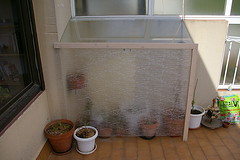
Here you have my new super-greenhouse!
130x120x50cm

Material needed:
– 130x90cm 5mm glass
– 2.5m wood stick (x2)
– 2x1m polystyrene-glass surface
– 100ml of water resistant paint

Lessons learned:
– Julio, stop thinking about building things!
– Pine tree wood is not convenient for outdoor, despite is the cheapest wood. They say teakwood is perfect (or other wood from wet jungle trees). Anyway, I made it with the first one, and painted it with a special water resistant paint.
– Cutting real glass is not as easy as you see in youtube videos. First I tried to cut glass to make the wall, but the result was quite ugly. So then I bought plastic glass (2x1m for 40€, cheaper than real glass).
– In order to cut polystyrene-glass you need to adjust your electric saw at top speed. At low speed the fiber starts to oscillate and breaks easily. At high speed the cut is sealed after the saw moves on, due to the heat!, but later you can hit the join and split the parts.

By the way, compare it with my last year prehistoric balcony greenhouse.

FriendFeed first impressions

In my previous post I criticized Facebook (“Fb”) quite a lot. But at the end it does some good stuff, like the “keep in touch with your people” thing, a decent content aggregator and a way to publish (or share) things like personal mood or thoughts, links, images, etc. But if you distill some of these good parts of Facebook, and improve them, you get FriendFeed (“ff”).

FriendFeed is a content aggregator which is far more complete than the one in Facebook (compare just the numbers: on Fb there are 13 possible sources to aggregate from, and 57 in ff). Actually Fb aggregator is quite bad, because some sources are not updated, and you need a 3rd part app to do so. ff has also a way to share links, images and such, and it’s really impressive (just add its Bookmarklet in your bookmarks bar and see its power). Moreover you get the usual “publish what are you doing”, “like it” and “make a comment” actions.

But the most pleasant thing I found is that it is a real Web 2.0 site. You add content, everybody see it, and there is RSS. Try to search for RSS in Facebook, find nothing. You can even get a widget (as you see on the right column, if you are visiting www.liopic.com). The groups (called “rooms”) are meaningfulness, with current people interested in the subject of the room.

Anyway there are 2 things that I miss from Fb that I’d like to see in ff. First is “events”, a way to invite people to an event and mark dates (despite there are complete websites that do just so). Second is “amount of people”… but this is a question of time: first time I entered in Facebook nobody was there, a year later a lot of people signed up. Let’s hope same thing will happen in FriendFeed.

So, see you there.

Facebook, or waste your time channel surfing

Have you ever feel how fast the time goes by when you do some channel surfing on TV? “I spend 2 hours in front of the TV, changing from one channel to another, and finally I’ve not seen anything at all”. I had this thought of “wasted time” while surfing on Facebook recently.

Fb, the origins
I logged in on Facebook some months ago, but I didn’t understand the meaning of the website at first. I came from social websites that focus on one thing, like Flickr (pictures) or Last.fm (music listened), so it was a bit weird to see a social website which end is the social relation itself, without a “theme”. Moreover the only friends you are supposed to have there (and to let them see your profile) are just the friends you currently have in Real Life, so basically Facebook aims to be a copy of Real Life society. So don’t expect new friends, just expect to see what your current Real Life friends are doing… but basically you can do so with other methods, like IM. I mean, when I use Internet, I don’t expect to see a mirror of Real Life, I expect to see different things, improved things… or just surf Wikipedia.

Fb, closed to foreigners
Another surprising thing is that your profile is private, a random net user can’t see it, unless he is your friend. This “closed” philosophy as default annoyed me. It could make sense, to keep your data from public. But coming from websites where you add content, mostly public (like photos in Flickr), and let the world see your stuff, this philosophy is at least paranoiac. Of course you can mark pictures as private in Flickr, and you can open your Facebook profile to everybody, but how many people do so? How many know how to do so? The default settings are the ones that show the website philosophy.

Fb, the false sense of security
Despite it claims for keeping your stuff away from foreign eyes, there are a lot of back-doors to overpass the private settings. The easiest one is just see Mr.X friends list, and look for one with open/visible profile, let’s say Ms.Y… then you can see pictures tagged with Ms. Y, even from the Mr.X picture sets… finally you get full access to Mr.X pictures. Another way is creating an application, using Facebook API: when somebody uses your fancy app, you can get FULL access to all his data, and can (for example) save it in your personal server. So you only need to create a small test app (“How freak are you?”) to harvest a lot of private data.

Fb, trying to create content
Of course in a social website without theme there will be less content created, and user will come back less often. Therefore Facebook staff have to help people to produce content, in order to induce other people to revisite the web often. One way is acting as an “aggregator” (gets content from other web2.0 places, like Flickr or del.icio.us, and publish again in user’s page). Other is creating an API to create applications. 3rd part developers come to create apps, salivating by the amount of possible users for their apps, and Facebook is happy to see more stuff in his system. I created a couple of Facebook apps and I can claim that their API is a torture. Basically they don’t let you use libraries, like jQuery, so you are forced to write old style code. Later you discover you can ignore it and create an iframe for your app… so that means your app is not a real Facebook app, just a nice Facebook frame that borders you website in your personal server.

Fb, a waste of time
So, I can guess that the 80~90% of produced or pseudo-produced content in your profile (or friends profile) is low quality. Do you really need to know that your old friend from school Harry loves chocolate? Nah!

Of course Facebook has good things: the content aggregator and a way to publish things neither short nor long in a fast way… but for such things you can use a better website, like Friendfeed.
Time of changes

The economic meltdown seems to encourage new ideas to blossom up, making classical product borders less noticeable. I’m focusing on hardware technological products today, but this probably applies to all kind of products, even financial ones.

I’m going to show you a couple of interesting examples I saw in the last few days:
Open Pandora, “Handheld Linux Console” : Some years ago somebody had the brilliant idea of creating a really small laptop, without a real old-style hard disk, and called it “net-books” (referring to notebooks + net support). Then we had PDA, net-books, and normal laptops. My small laptop (12″ screen) is still a laptop, but when I bought a Nokia 770 (theorically “Internet Tablet”, actually a PDA with Linux) it was just difficult to answer “what is it?” to not tech people. And now I’ve fallen in love with this “strong-PDA-like with keyboard in a Nintendo-DS structure made for playing games but which actually is a complete net-book with Linux”. Damn, I’ll need to memorize this description.
OP-1 synthesizer and controller : In the old times, you hadn’t a lot of options to look for when thinking about creating electronic music. Basically a synthesizer. Then Yamaha created the TenoriOn. And now I stared my eyes on this toy synthesizer, with FM radio and sequencer, created by designers. I can’t set a category for this, except the obvious “I Want One”.

Moreover one detail to think about this products is that there isn’t a big traditional company behind them. A synthesizer created by a group of designers? Sounds weird, but those mixes of disciplines are the future. Also it’s interesting to read about OpenPandora history. A guy annoyed with a Korean idea, another guy, Texas Instruments looking for a machine to test its new chip…

Reading Life & Death Go problems

“Tell me, I’ll forget
Show me, I’ll remember
Involve me, I’ll understand”
– Chinese proverb

L&G problemSome weeks ago I borrowed a baduk (Go in Korean) book from my Go teacher. It’s part of a collection of books by Lee Chang Ho (이창호), written in Korean, so I can just understand the diagrams. Luckily this book speaks about life and death, so it’s not difficult to follow. It shows L&D in a way I’ve not seen in English books on this matter. Shows a shape, and starts doing subtle variations (a extra liberty here and there) and surprisingly the way to solve all those similar problems are quite different. Which helps you to think, to calculate the position, to avoid storing the shape in your memory and forgetting about the details.
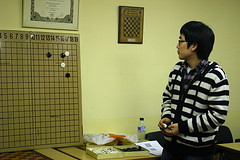
So, in order to copy some of these interesting problems before I give back the book, I decided to add them to goproblems.comEnjoy them!

Sixth Sense

In my previous work I enjoyed when some coworkers tried “visual things” using a webcamera and a soft to recognize hands, fingers and such. This morning I saw a video with the last research on the field… impressive:

Link to the video

Which technology will win in the input world? Cameras or multi-touch screens?

Feeling as a senior programmer

Here it is a morning conversation with my new Hindi junior coworker. He is in New Delhi, working for us remotely, and I’m teaching him quite a lot of things, and love to discuss about programming problems…

Me – have you read about Composite Pattern?
He – i use to say to my friends that am good at programming, then I found you 🙁
Me – hahaha
He – right now reading Pragmatic Programmer, 🙂
Me – really? really good
He – planning to apply for zend certification so I’ve so much to study
Me – This book changed the way I think about programming

La Maison en Petits Cubes

Perhaps, the only interesting detail to look at the winning Oscar list of each year is the short animation section nominees. Some years this Oscar goes to a western author, but I love when it goes to an Asian author… then I try to find the short on Internet, expecting a beautiful flow of images, metaphors and silk music. Like this year winner, “La Maison en Petits Cubes”:

Part 1/2:


Part 2/2:


2 more beautiful videos to add to my list of Oscar’s winners or nominees in the animation section.

Assuming mistakes in your games

We are humans“: that’s the summary of this year’s Barcelona Go Tournament. Each year a lot of emotions cross my body the day before and the weekend of the tournament. Meeting again a lot of good people, play serious games, play unofficial games, chat, tell jokes, get delighted by some people explaining some new moves… too many things to express. This time I was really prepared to defend my level, and try to get some points to upgrade it… and I did it. I won in 2 out of 5 rounds, but again stronger opponents.

New joseki, step 1 However I felt I was winning most of my games. I felt confident with my moves, so severe that just looking at my opponents’ faces I realized how scaring my moves were. But I’m a human, a real human, and I made mistakes, that ruined some results. All my opponents were really strong, so that means I’m also strong, sometimes stronger than them. Anyway the luck decided some games, making true the sentence “the winner doesn’t usually win because his smart moves, but because his opponent mistakes“, or better said, “the player who do less mistakes win the game“.

So, the way to handle this is (apart than a smile) to assume you will commit mistakes, and try to prepare plans to recover from them. You don’t only play against your opponent, but also against your own mistakes. Knowing them (the types, the situations when they appear, etc) can help you to avoid them spoiling a game. Discover when you may fail, and prepare a B plan. Easy to say, but hard to apply… but it is the WAY.

“To secure ourselves against defeat
lies in our own hands,
but the opportunity of defeating the enemy
is provided by the enemy himself.”
– Sun Tzu (from The Art of War)

Keep your freezer without air!

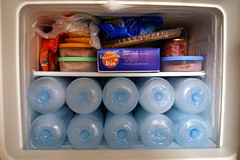
Freezer Why am I keeping this amount of bottles in my freezer?

Freezer (and fridge) are designed to keep the inside content cool. But it’s funny to realize that most of the content is air. Each time you open the freezer you force to move the inside air with the outside… and the inside temperature rises. How can we avoid it? Keeping a lot of things, in order to minimize the air’s volume. This way the freezer doesn’t “complain” (activates the compressor of the freezing gas) every time the door is opened (even for taking pictures). I’ve chosen water bottles because it’s quite easy item to get at home, but if you can get some concrete blocks or solid bricks, you’ll get an even better result.

With some energy-saving bulbs, this idea and some more ideas, my electricity bill is only 13€ per month.

Idea developed from: 100 ways to reduce your impact (some good and some slack) and “Proper Education” video clip (a remix of Eric Prydz of the classic “We don’t need no education” by Pink Floyd).